Radio Astronomy portal
Welcome aboard
You are now on the team. This page tells you where everything is, how to catch up quickly, what is still open and how to start contributing. For the background of the project, see the public project page.
What is where
- Telescopes: the PSU and PNU fixed telescopes and the active DISH222, with what each one measured.
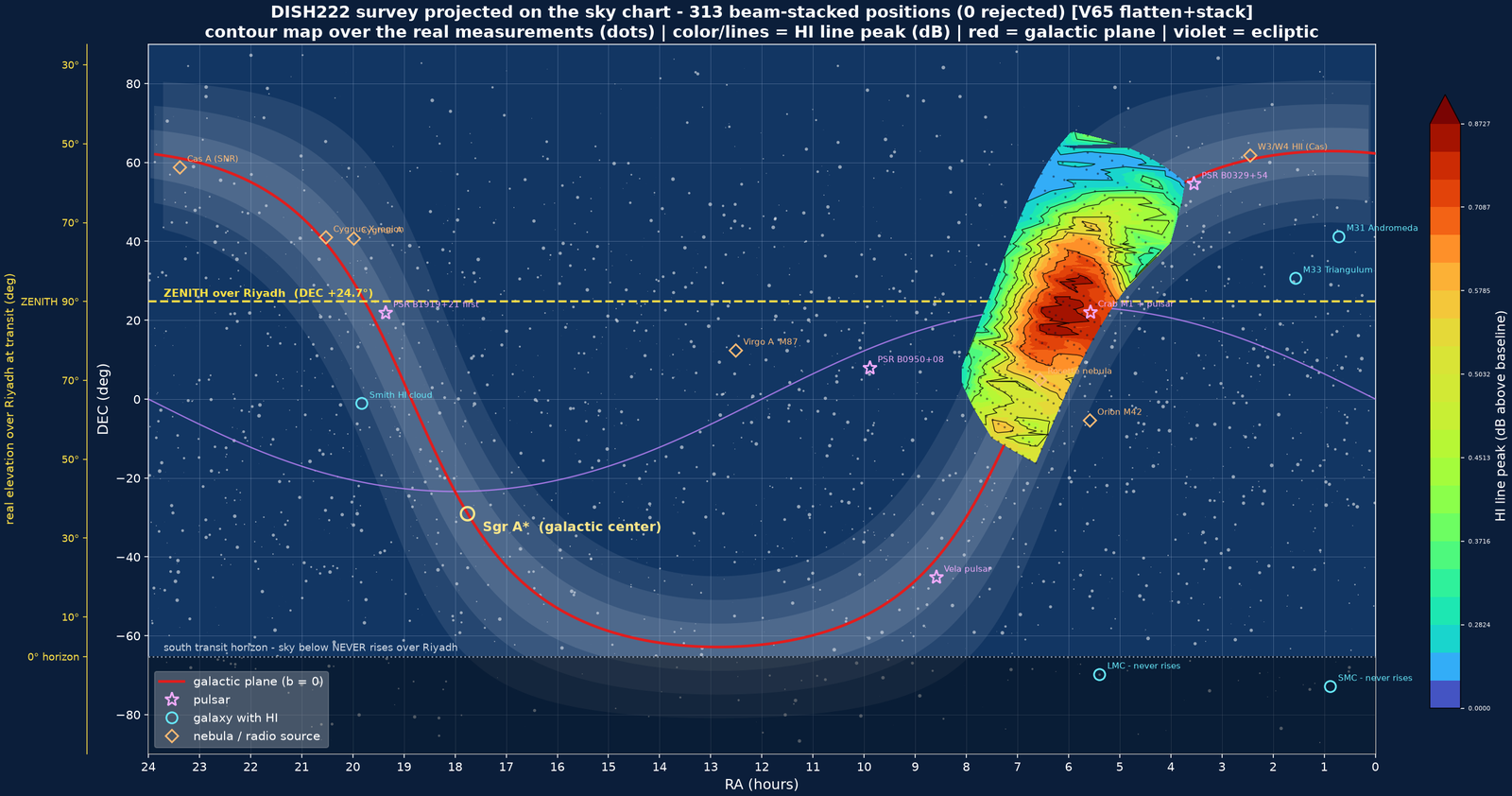
- Data Library: observations as coherent datasets, with the archives that expose their lineage. The recommended starting dataset is the 26 Aug 2026 outer-Galaxy raster.
- Data to Science: why each processing step is needed (time, velocity, calibration).
- Research: open questions and starting points.
- Project Log: what happened, when.
Every dataset is tagged with a processing level (L0 to L8) and a calibration scale. Historical records are never altered; modern products are linked to them by provenance.
Where the project stands
A research project is never finished. This is an honest summary as of late September 2026, mostly about the DISH222 data.
Demonstrated
- Automated raster scanning of the Galactic plane: the 26 Aug 2026 session visited 313 sky positions and recorded 776 averaged spectra.
- H I brightness and velocity maps of the outer Galaxy, first on a relative (dB) scale.
- Pointing improved from several degrees of error to about 1° after a Sun-based pointing calibration.
- A kelvin temperature scale that went through five documented stages; the current one (C4) reproduces the LAB survey at eight reference positions with about 8.5 K scatter.
Still open
- No complete observational product has yet been independently reproduced end-to-end, from native spectra to a final science product (nothing at level L8). Individual calibration calculations, such as the C4 eight-point fit, have been checked independently.
- The current calibration (C4) has not been applied to any archived map; existing products stay on their original, historical scales.
- The receiver noise temperature (about 860 K) limits sensitivity, and a small baseline pedestal is corrected only approximately.
- Native spectra behind the September products and the all-sky composite are not yet in the research archive.
How to catch up quickly
- Understand the fixed telescopes and what they measured.
- Look at a historical spectrum (the PSU fixed archive is awaiting ingestion).
- Understand the RA / sidereal-time correction.
- Learn frequency to velocity and calibration.
- Explore DISH222 data in the Data Library.
- Choose a research question.
The 52-slide interactive lecture teaches the principles behind these steps.
Reading the portal:
- C4 is the current calibration scale. Older products keep the scale they were made with.
- Values marked inferred come from analysis, not a direct statement in a source.
- Unknown details are listed as open questions rather than guessed.
Reference: Publication · Software · Resources · نظرة عامة بالعربية · من الحرم الجامعي إلى درب التبانة